
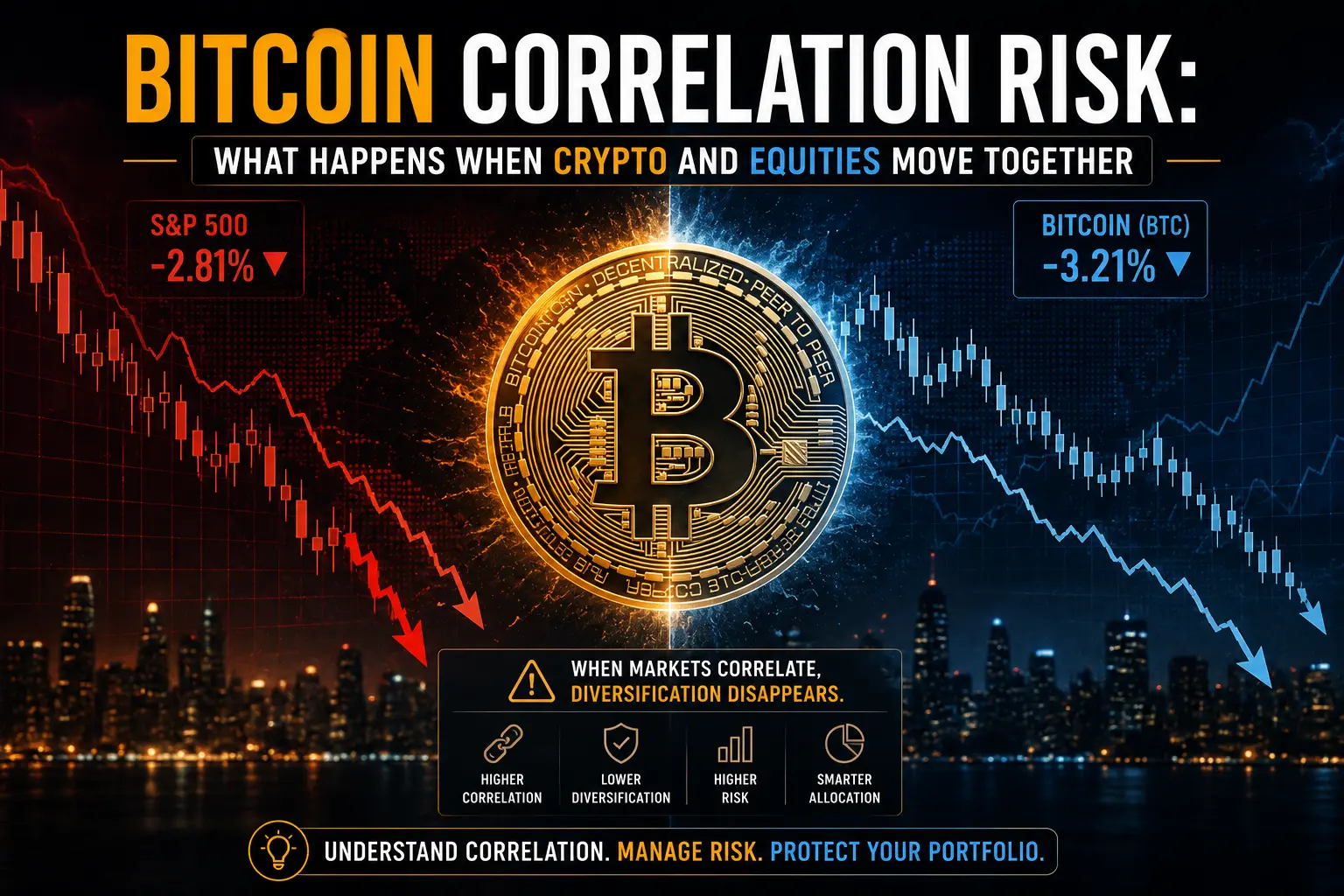
For years, part of the institutional pitch for Bitcoin has been diversification: a scarce, non-sovereign asset that moves independently of stocks and bonds. That pitch holds up reasonably well during calm markets. It tends to break down during the moments investors actually need it — sharp liquidity crunches, rate shocks, and systemic risk-off events, the same conditions we track in our Bitcoin macro analysis.
Key takeaways
Bitcoin's correlation to equities is not fixed — it rises sharply during liquidity crunches and falls during calmer periods.
"Uncorrelated" is a long-run, multi-year statistical tendency, not a guarantee during any single drawdown.
Treating Bitcoin as a pure diversifier without accounting for regime-dependent correlation overstates the portfolio protection it provides.
A risk-adjusted framework accounts for correlation regime, not just average correlation over time.
Correlation Isn't Constant — It's Regime-Dependent
Correlation between any two assets is rarely a single, stable number. It shifts with the macro environment, and Bitcoin's relationship with equities is a clear example. During periods of ample liquidity and risk appetite, Bitcoin has often traded with a low or even negative correlation to the S&P 500. During sharp deleveraging events — March 2020, mid-2022's rate-driven selloff — that correlation has spiked toward 1, as investors sold everything liquid to raise cash simultaneously.
This is the core insight behind Bitcoin risk-adjusted returns: a correlation figure calculated over a full multi-year window can mask the fact that correlation was near zero most of the time and near one exactly when it mattered.
Why Correlation Spikes When Liquidity Disappears
The mechanism is fairly consistent across cycles. When credit tightens or a shock hits markets broadly:
Leveraged positions across asset classes get margin-called at the same time
Investors sell their most liquid holdings first to raise cash — and Bitcoin, trading 24/7 with deep global liquidity, is often one of the first assets sold
Risk-parity and multi-asset funds reduce exposure across the board, not selectively
This is why Bitcoin has, at times, sold off alongside equities even when the two assets have no obvious fundamental link. The correlation isn't about Bitcoin and stocks sharing a thesis — it's about both being sold by the same distressed sellers at the same time. This dynamic is central to how we frame global liquidity as an input to position sizing, not an afterthought.
What This Means for Portfolio Construction
None of this invalidates Bitcoin's long-run diversification case — over multi-year periods, its correlation to traditional assets has generally remained lower than most single-stock or sector exposures. But it does mean a portfolio built assuming Bitcoin will reliably cushion an equity drawdown is making an assumption that hasn't always held during the sharpest moments.
A more accurate approach is to treat correlation as regime-dependent input, similar to how cycle-aware investing treats price cycles: understand which macro regime you're likely in, and size exposure accordingly rather than assuming a static relationship. This is also why comparisons like Bitcoin vs. gold matter — gold's correlation behavior during liquidity events differs meaningfully from Bitcoin's, and a portfolio that leans on one for the other's job can end up under-diversified exactly when it counts.
Building Correlation Awareness Into a Risk Framework
For high-net-worth investors and family offices, the practical implication isn't to abandon Bitcoin as a diversifier — it's to stop treating "uncorrelated" as an unconditional label. A disciplined framework asks:
What is the current liquidity regime, and how has Bitcoin's correlation to equities behaved in similar past regimes?
Is portfolio sizing assuming a diversification benefit that may not hold during the exact scenario the position is meant to protect against?
Does the broader risk framework account for correlation spikes, or only average historical correlation?
This kind of regime-aware thinking is embedded in the institutional risk framework MCG builds with clients — treating correlation, like volatility, as a variable to plan around rather than a fixed assumption. See our Services page for the full framework, or request the Bitcoin Risk Management Playbook.
Frequently Asked Questions
Is Bitcoin correlated with the stock market?
Bitcoin's correlation with equities varies significantly by macro regime. It has often traded with low or negative correlation during calm, liquid markets, but correlation has spiked sharply higher during sudden deleveraging events and liquidity crunches.
Why does Bitcoin sell off with stocks during a crash?
During sharp risk-off events, leveraged positions across asset classes get unwound simultaneously, and investors often sell their most liquid holdings — including Bitcoin — to raise cash. This creates temporary correlation spikes driven by forced selling rather than a shared fundamental thesis.
Does this mean Bitcoin isn't a good diversifier?
Not necessarily. Over multi-year periods, Bitcoin's correlation to traditional assets has generally remained lower than many single-stock or sector exposures. The nuance is that this diversification benefit is regime-dependent and can weaken precisely during the sharpest drawdowns.
How should investors account for correlation risk in portfolio sizing?
Rather than assuming a static correlation figure, a disciplined framework considers the current liquidity and macro regime, historical correlation behavior in similar regimes, and whether position sizing already assumes a diversification benefit that may not materialize during a given drawdown.
How does MCG factor correlation risk into its Bitcoin advisory framework?
MCG treats correlation as a regime-dependent variable within its broader macro and liquidity framework, sizing and adjusting Bitcoin exposure based on the prevailing liquidity environment rather than assuming a fixed, static relationship to equities.
This article is for educational purposes only and does not constitute investment, legal, or tax advice. Market Capital Group is not a broker-dealer, exchange, or registered investment adviser. Past performance is not indicative of future results.