
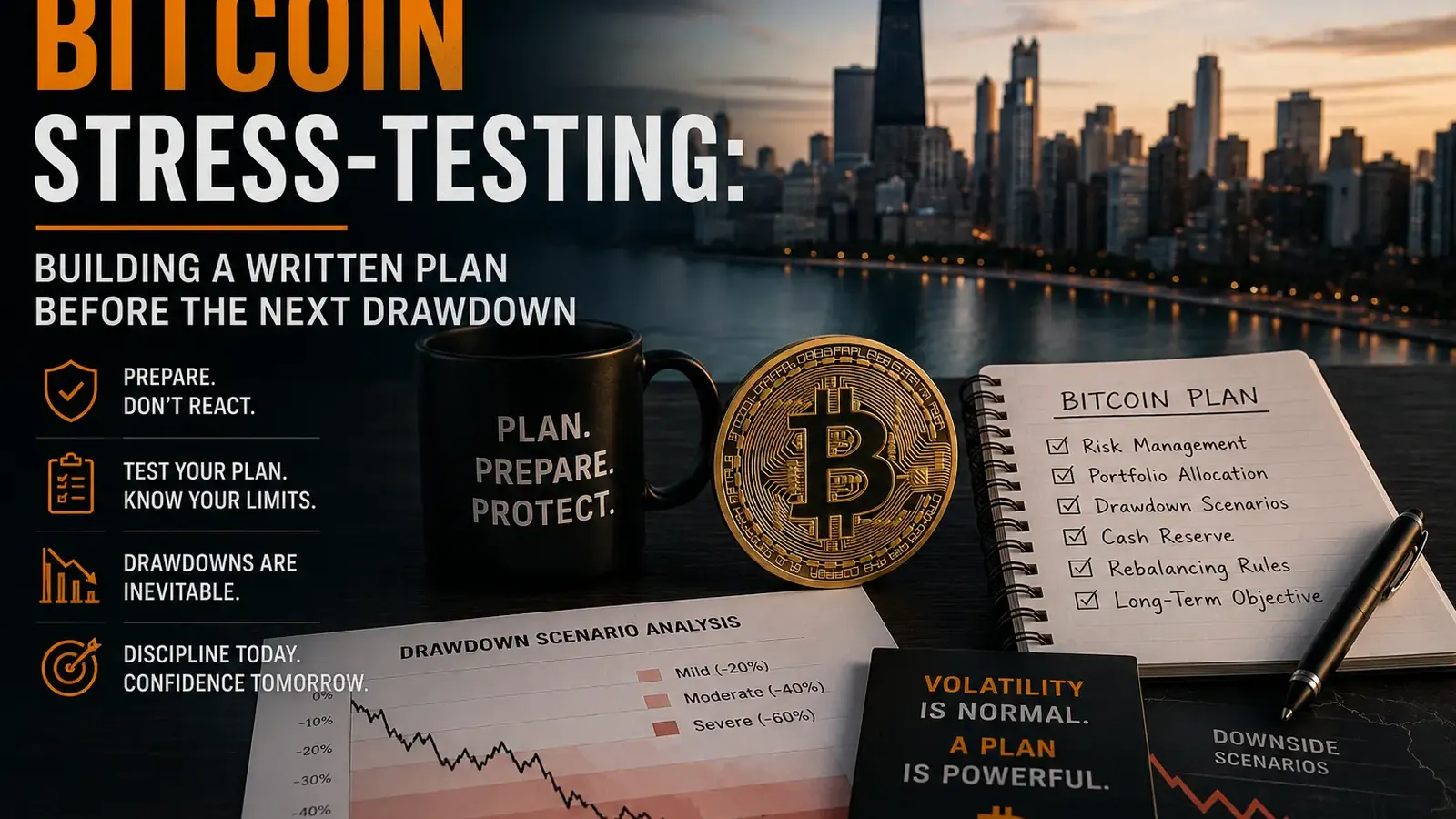
Investors who stress-test their Bitcoin holdings in advance tend to make calmer, better decisions during an actual drawdown than those who are figuring out their response in real time. The exercise itself — walking through specific decline scenarios and pre-committing to a response — does more for long-term outcomes than any attempt to predict when the decline will occur.
Key takeaways
Stress-testing means rehearsing specific decline scenarios in advance, not predicting when a decline will happen.
A useful stress test covers a range of severities, including Bitcoin's historical worst case of an 85% peak-to-trough decline.
The output of a stress test should be a specific, written action plan, not just an awareness that a decline is possible.
Stress tests should be revisited periodically, especially after significant portfolio or life changes.
What Stress-Testing Actually Involves
A Bitcoin stress test walks through a series of decline scenarios — for example, 30%, 50%, and 85% — and asks, for each one, exactly what the investor's plan is: does the position get held, trimmed, or does the decline trigger a review of the broader portfolio's liquidity needs. This exercise turns an abstract risk into a specific, rehearsed decision, directly informed by the psychology of holding through a real decline.
Why the Output Has to Be Written Down
A stress test that lives only as a mental exercise tends to evaporate under real market pressure. The value comes from writing the plan down in advance — specific triggers, specific actions — so the investor isn't improvising a response while emotionally invested in the outcome, closely tied to when a position would actually be reduced.
Testing Against Realistic Macro Scenarios
A thorough stress test doesn't just model an isolated Bitcoin decline — it considers how a broader macro stress event might move Bitcoin alongside equities and other correlated assets simultaneously, informed by current macro conditions, since a real drawdown rarely happens to Bitcoin in isolation.
Where to Start
See our Services page, or request a consultation to build a written stress test before your next drawdown.
Frequently Asked Questions
Isn't stress-testing just predicting a crash? No — it's rehearsing a response to declines of varying severity, regardless of when or whether they occur, so the response is already decided in advance.
How severe should the worst-case scenario be? It should include Bitcoin's historical worst case, roughly an 85% peak-to-trough decline, even if that scenario feels unlikely in the current environment.
Why does the plan need to be written, not just discussed? Because decisions made under real market stress are unreliable — a written plan removes the need to improvise while emotionally invested in the outcome.
Does MCG build stress tests for client portfolios? Yes. Stress-testing across a range of decline scenarios is a standard part of MCG's written risk framework for each client.
This article is for educational purposes only and does not constitute investment, legal, or tax advice. Market Capital Group is not a broker-dealer, exchange, or registered investment adviser.
Related reading: Psychology of Bitcoin Holding · When to Sell Bitcoin for High-Net-Worth Investors · Bitcoin Correlation Risk · Bitcoin Macro Analysis